
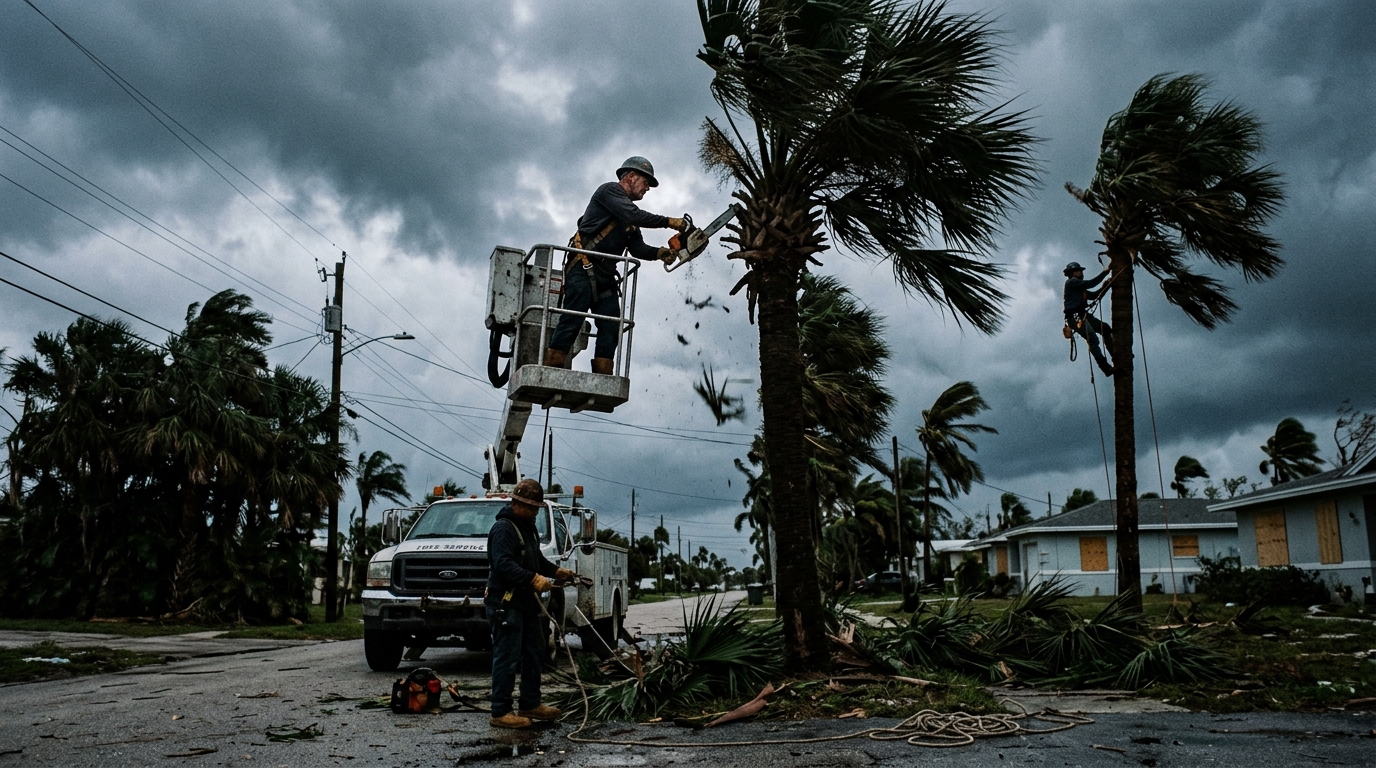
Why You Must Trim Your Palm Trees Before Florida Hurricane Season
Why You Must Trim Your Palm Trees Before Florida Hurricane Season
Palm trees are the iconic symbol of East Volusia County. Whether you have towering Sabal Palms lining your driveway or massive Canary Island Date Palms anchoring your front yard, they add undeniable tropical beauty to your property.
However, when Atlantic Hurricane Season arrives (running from June 1st to November 30th), neglected palm trees transform from beautiful landscaping into incredibly dangerous, high-altitude projectiles.
Here is why scheduling a professional palm tree trimming before the next tropical storm is the most critical landscaping task for Florida homeowners.
1. Dead Fronds Are Lethal Projectiles
Unlike oak or maple trees that snap and fall, palm trees are incredibly flexible and evolved to bend in hurricane-force winds.
The danger lies not in the trunk, but in the heavy, dead palm fronds hanging from the canopy. When hit with 100+ mph wind gusts, these dead fronds (which often have razor-sharp thorns and weigh over 15 pounds) break loose and are launched horizontally like spears. They can easily shatter your home's windows, destroy your screen enclosure, or cause catastrophic damage to your parked vehicles.
2. Reducing Wind Resistance (The "Hurricane Cut")
A healthy palm tree has a full canopy, but a dense canopy acts like a giant sail during a hurricane.
By having a professional arborist perform a pre-storm "Hurricane Cut" (removing dead fronds, heavy seed pods, and coconuts), you drastically reduce the wind resistance of the tree's crown. This allows the high winds to pass smoothly through the remaining healthy fronds, significantly reducing the stress on the trunk and preventing the tree from uprooting entirely.
3. Protecting Your Roof and Power Lines
Palm fronds grow incredibly fast during the wet Florida summer. If your fronds are hanging over your roof, the constant scraping caused by storm winds will violently tear the shingles or tiles off your home, leading to immediate water intrusion.
Furthermore, if your palm trees are located near power lines, a single dead frond blown into a transformer can cause a massive neighborhood power outage and create a lethal fire hazard on your lawn.
Why DIY Trimming is Dangerous
Trimming a 30-foot palm tree is not a DIY weekend project. It requires heavy machinery, specialized harnesses, and strict safety protocols. Furthermore, improperly cutting green, healthy fronds can permanently stunt the tree's growth or introduce fatal diseases.
Protect your home, your family, and your landscaping this hurricane season.
At Green Side Up Sprinkler Repair, we partner with the best landscaping and tree experts in East Volusia County to keep your property pristine and safe.
Contact us today to ensure your property is ready for whatever the Florida weather brings!
FAQ
How often should palm trees be watered? Newly planted palm trees require frequent watering, but established palms are quite drought-tolerant and generally only need deep watering once or twice a week depending on the weather.
What is the best way to light a palm tree? Up-lighting is the most striking way to illuminate a palm tree. Positioning a spotlight at the base angled upward highlights the trunk's texture and the canopy's structure.
Can sprinkler water hitting the trunk harm a palm tree? Yes, frequent overhead watering that hits the trunk can lead to fungal diseases and trunk rot. Drip irrigation or bubblers at the base are safer alternatives for palms.